ServicesReverse Osmosis System
Reverse Osmosis System for Your Kitchen in Sun Lakes
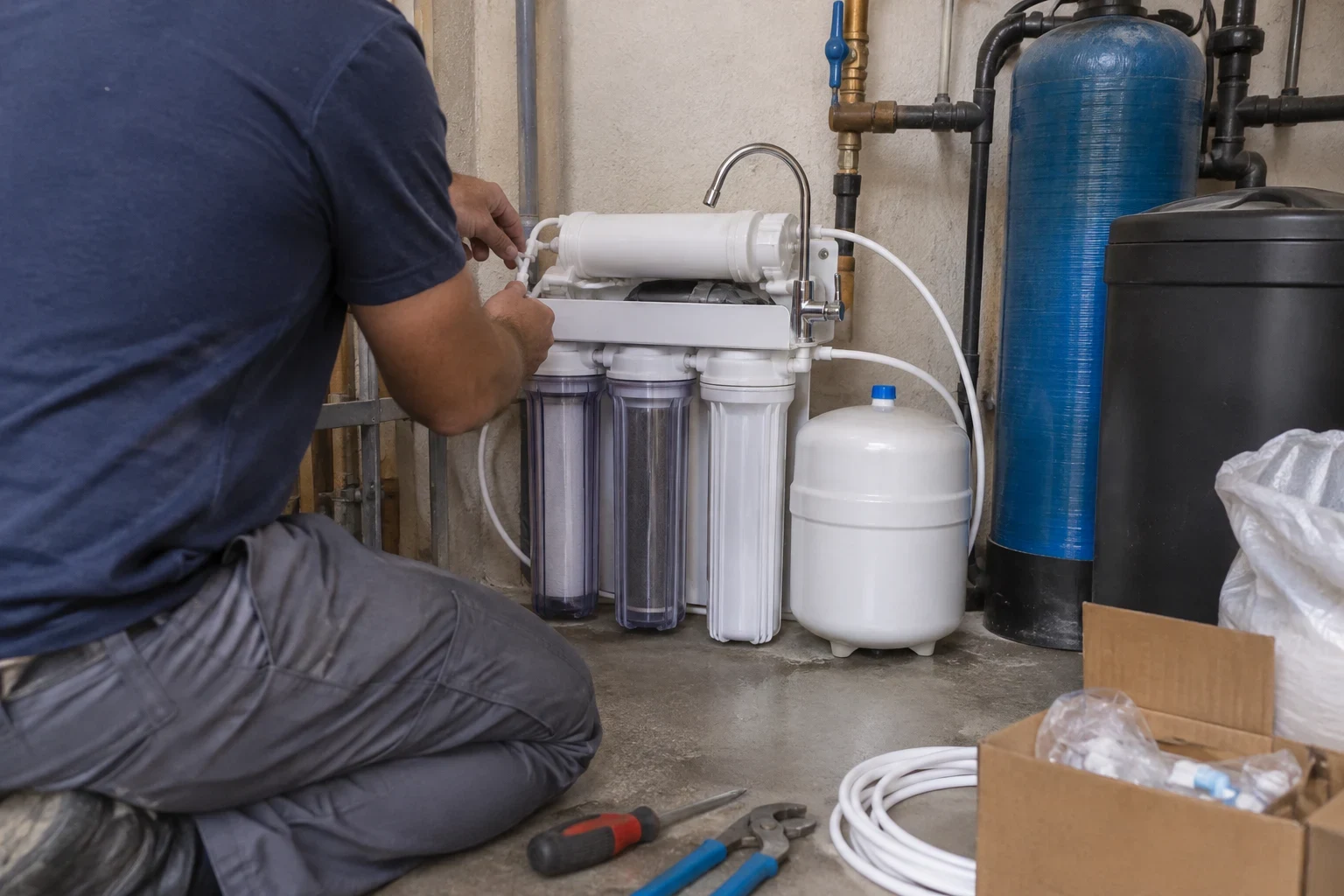
An under-sink reverse osmosis system gives your kitchen its own faucet of low-mineral water for drinking, coffee and cooking. Four filter stages pull out dissolved solids and chlorine taste, and we keep a photo record of each fitting we connect beneath your sink.
What a Reverse Osmosis System Does at Your Sink
Inside the system, ordinary line pressure forces water against a thin-film membrane so fine that dissolved salts, metals and most other ions cannot get through. The filtered water, called permeate, fills a small pressurized storage tank, while the concentrated minerals rinse away to the drain. Ahead of the membrane, sediment and carbon cartridges take out grit and chlorine. After the tank, a carbon polishing filter removes any taste the water picks up while it sits.
It is the right call when you want better drinking and cooking water from one tap without treating every gallon in your home. Water across the Phoenix area carries a heavy load of dissolved minerals, and RO is one of the few home methods that brings that number down sharply. If your goal is softer showers and less scale on fixtures, look at water softener installation or whole-home filtration instead, or pair one with RO.
We work the same way on every job: we photograph the plumbing we find under your sink, each part as it goes in and the finished cabinet, so you know exactly what was installed and where.
What the Install Includes
- 01
Multi-stage filter housings
A sediment prefilter, a carbon block prefilter, the RO membrane and a carbon postfilter, mounted to the cabinet wall so the housings do not hang on the tubing.
- 02
Feed valve on the cold line
We add a dedicated feed valve at your cold water angle stop. If that stop is corroded or will not close fully, we show you the problem and explain the replacement before we touch it.
- 03
Drain saddle and air gap
The reject water runs to a drain saddle on the sink tailpiece, above the trap. Placement matters: too close to a garbage disposal outlet and food can back up toward the membrane.
- 04
Dedicated faucet
A separate drinking water faucet goes in an existing sprayer or soap hole, or a new hole drilled in the sink deck or countertop.
- 05
Storage tank and shutoff
We pre-charge the tank to the right air pressure and confirm the automatic shutoff valve stops production once the tank is full, which keeps water from running to drain all day.
- 06
A record of the finished job
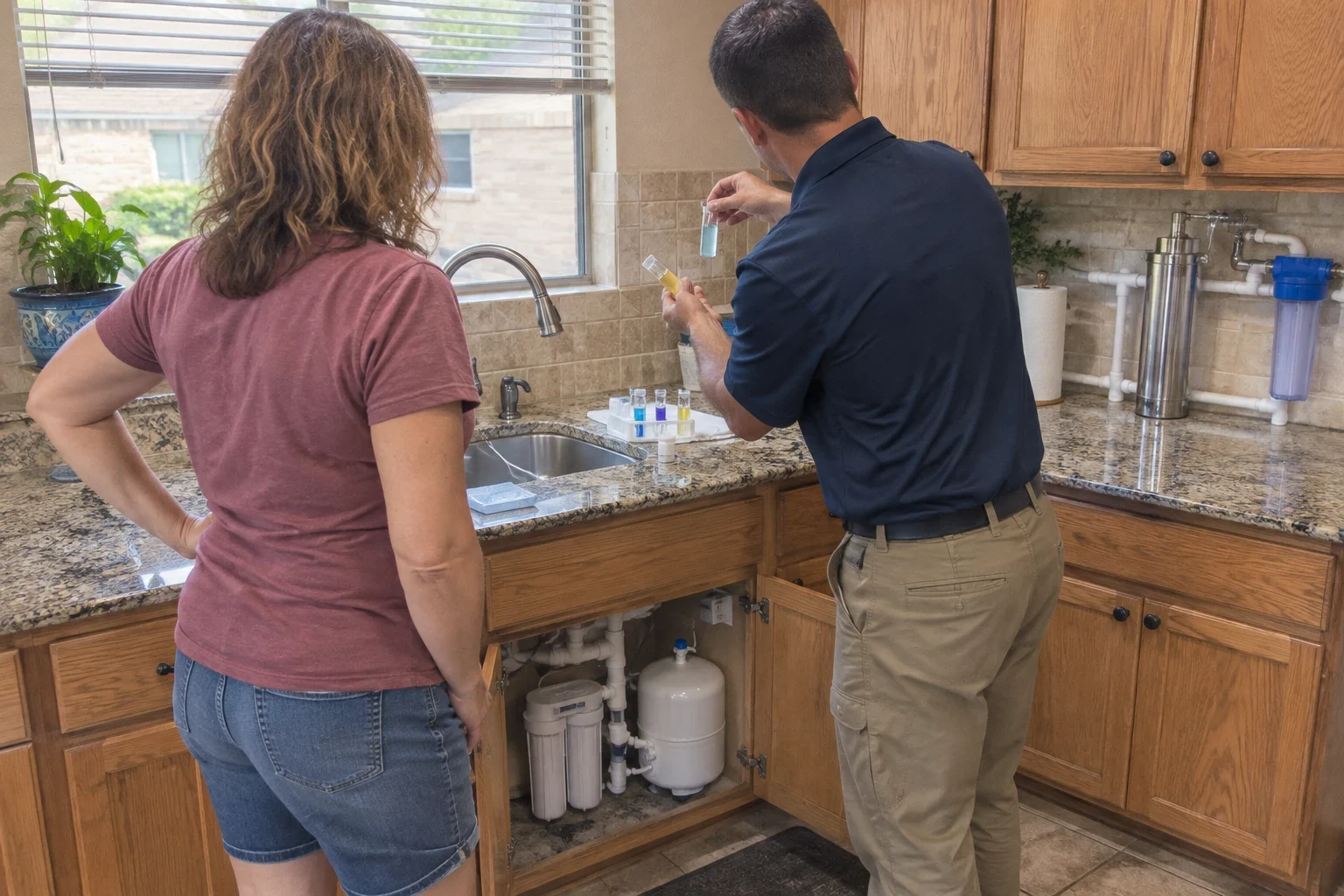
You receive photos of the original plumbing, each connection and the completed cabinet, plus a dissolved solids reading taken at the RO faucet after the system has flushed.
Questions about Reverse Osmosis System?
Call(480) 613-3633Signs an RO System Makes Sense for Your Home
White crust in the kettle
Scale in your kettle, coffee maker or steam iron is dissolved calcium and magnesium dropping out when water heats. RO removes most of it before it reaches the cup.
You haul bottled water
If you buy cases or refill jugs every week, an RO faucet gives you comparable water on tap without the trips or the plastic.
Chlorine taste or smell
Utilities disinfect water with chlorine or chloramine. It is safe, but many people dislike the taste, and the carbon stages in an RO system take it out.
Cloudy ice and spotted glasses
Minerals freezing out of solution cloud ice cubes and leave rings on glassware. Running the RO line to your refrigerator clears both.
An old RO unit that runs slow
A tank that takes all day to fill, a dripping faucet or water that tastes flat or stale usually means a fouled membrane, a waterlogged tank or a failed check valve. We can replace the system and show you what wore out.
From First Call to First Glass
- 1
Start with a phone call
We ask what kind of sink and countertop you have, whether there is a disposal and if the refrigerator needs a line. Those answers decide the system and faucet we bring, so nothing gets swapped on the day.
- 2
Look under the sink
We check cabinet space, the angle stop, the drain layout and your incoming pressure. RO membranes need steady pressure to work well, so if yours runs low we explain a permeate pump or booster pump and why it helps.
- 3
Install and document
We shut off the cold supply, mount the housings, run color-coded tubing and set the faucet. Each connection is photographed as it goes in, and we lay down a towel and clear the cabinet afterward.
- 4
Flush and check for leaks
New carbon filters release fine dust and a new membrane carries a preservative, so we drain the first tankful or two. We check every fitting dry with a paper towel and take a final reading at the faucet.
What Moves the Price of an RO System
We quote by phone once we know your sink setup, and we explain what is behind the number. Most of the gap between two RO installs comes from the system you choose and the work needed to fit it into your kitchen.
- System design
- A basic four-stage unit with a storage tank costs less than a tankless model with its own built-in pump. Adding a mineral cartridge, which puts a little calcium and magnesium back for flavor, also raises the price.
- Faucet hole and countertop
- An unused sprayer or soap hole makes the faucet a quick job. Stone tops like quartz and granite have to be cored slowly with a diamond bit, so they add labor that a stainless sink deck or laminate counter does not.
- Extra lines
- Running permeate to a refrigerator or a second sink adds tubing, fittings and labor, more so when the run passes through cabinets or a wall.
- Pressure and plumbing condition
- Low incoming pressure may call for a pump. A seized angle stop or a worn tailpiece needs replacing before we connect to it, and we point it out to you before any work starts.
Reverse Osmosis Questions We Hear Often
Does an RO system waste a lot of water?
Some water always leaves through the drain line, because the membrane needs a reject stream to flush away the minerals it holds back. The more dissolved minerals in your supply, the higher that share runs. A permeate pump and a properly working automatic shutoff both reduce the waste a good deal, and we plan the setup around that.
Does RO remove the minerals I actually want?
It takes out most calcium and magnesium along with everything else. Food supplies far more of those minerals than drinking water does, but some people find straight RO water tastes flat. An optional mineral cartridge after the tank adds back a trace of calcium and magnesium, which rounds out the flavor.
Do I need a water softener too?
You do not need one to drink RO water, but hardness scales the membrane sooner and shortens its life. If you already have a softener or are planning water softener installation, the RO system benefits from the softened feed. Without one, expect to replace the membrane more often.
How often do the filters need changing?
The sediment and carbon prefilters are usually replaced about once a year, and the membrane every few years depending on hardness and how much water you use. A tank that fills slowly or a climbing dissolved solids reading at the faucet tells you it is time. Your job record lists the install date of each cartridge so you can track it.
Will it fit with my garbage disposal?
In most kitchens, yes. The tank and housings sit beside or behind the disposal, and we put the drain saddle on the side of the sink away from the disposal whenever the plumbing allows. In a tight cabinet we can lay the tank on its side or suggest a compact tankless unit.
Can it supply my refrigerator ice maker?
Yes. We tee off the RO line and route tubing to the refrigerator, usually through the cabinet floor or a side panel. Ice from RO water freezes clear, and the dispenser water tastes the same as the faucet at your sink.
Get Better Water From One Faucet
Tell us about your sink and countertop, and we will explain which RO system fits and what the install involves. We serve Sun Lakes and nearby towns including Chandler and Gilbert.